


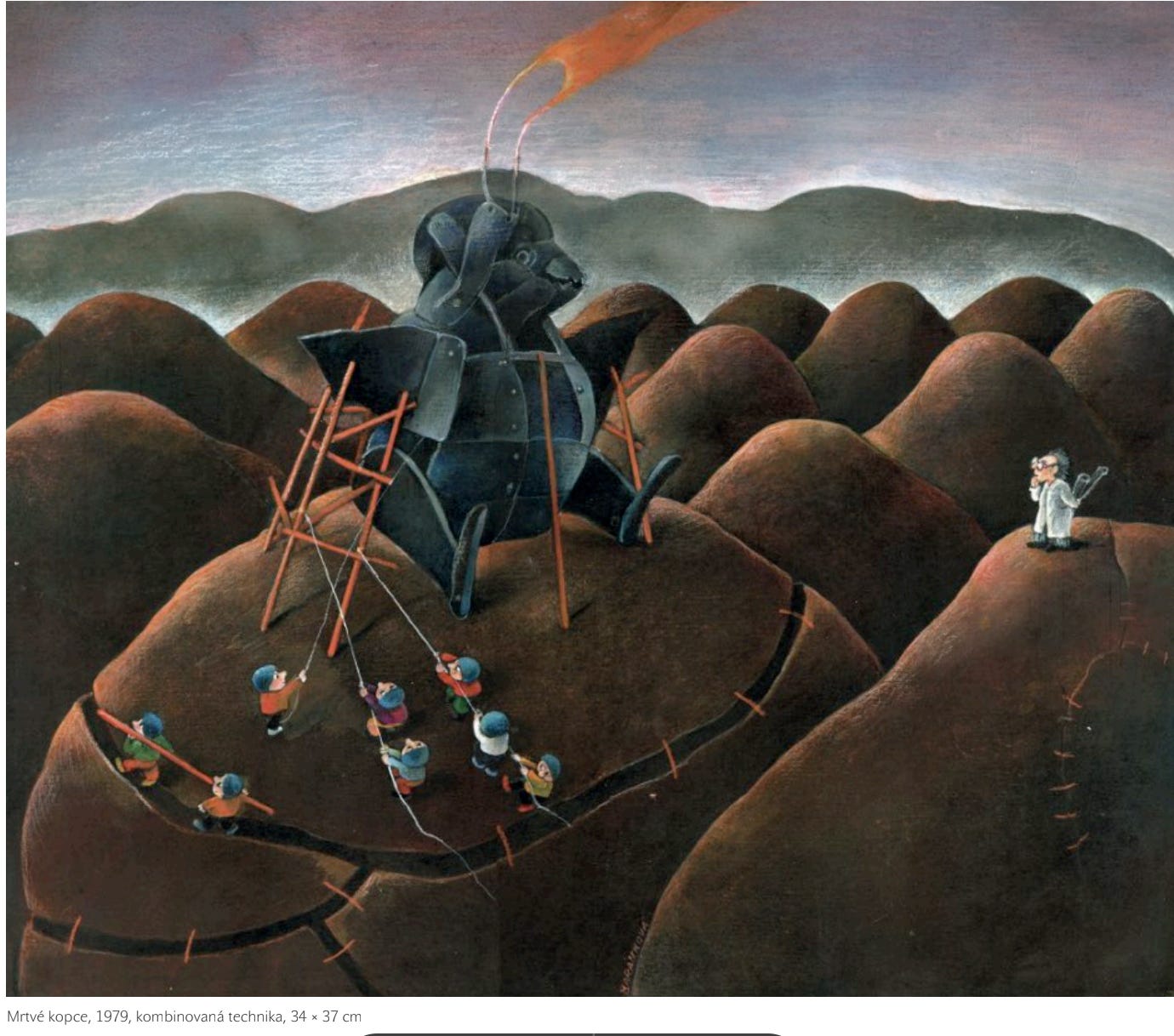
Contention: Whether you find our current “AI moment” at least somewhat intellectually stimulating depends largely (if not entirely) on your comfort with metaphors.
I know this will bother some of my more rabid anti-AI readers, but for all many misgivings about the role of AI in society at present, I am firmly and unapologetically curious about this new technology. More than curious, really. I am intellectually excited by the profound questions that AI poses regarding what we mean by intelligence, cognition, learning, abstraction, understanding—the list is long. What’s more, AI demands that we—and by we, I very much mean we humans—really grapple with the metaphors we use to make sense of ourselves, and those we use to help us understand these strange new tools we’ve created.
Recently, I wrote a mini-defense of the metaphor of “stochastic parrots” as an accurate and useful metaphorical description of the core function of generative AI in the form of large-language models. That’s a claim I’m making about generative AI as it exists today. But what about where things are headed? What metaphor should we use as our “north star”—hey look, another metaphor—to guide where this technology should be going? That’s the question I want to explore this week, using an interesting pre-print article published just a few weeks ago as my intellectual foil.
The article: AI Must Embrace Specialization via Superhuman Adaptable Intelligence, lead authored by Judah Goldfelder (currently a PhD student in the “Creative Machines Lab” at Columbia University), with Philip Wyder, Yann LeCun, and Ravid Schwartz-Ziv listed as co-authors—longtime Cognitive Resonance readers may remember my “AI insider spills secrets!” essay that featured LeCun’s many criticisms of LLMs as currently constructed. In any event, this new article is very readable, not overly technical, and offers up a very useful landscape graphic of the many metaphors and definitions hovering around the aspirations of the AI research field at present. To wit (and please pinch to zoom on mobile, sorry it’s so small):
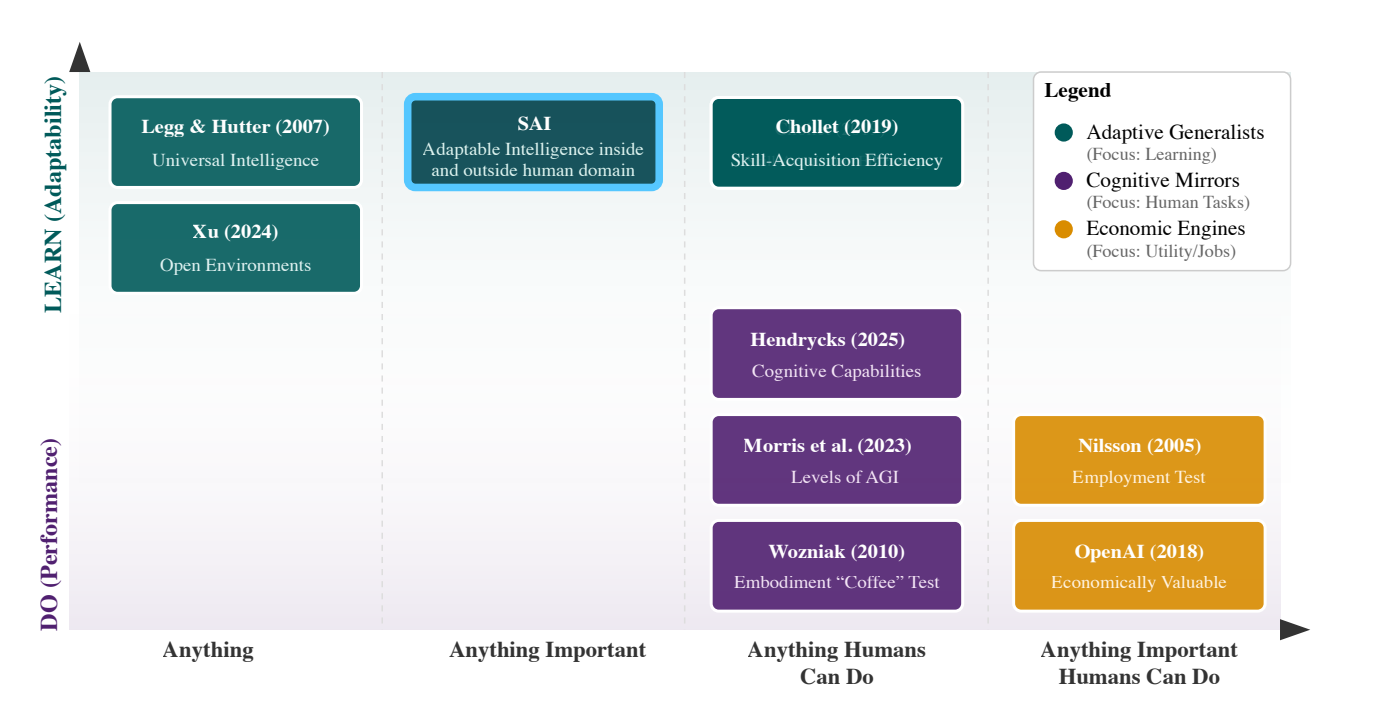
Stefon voice: Adaptive generalists, cognitive mirrors, economic engines, this landscape HAS IT ALL! Jokes aside, I think it’s very helpful summary of the competing “metaphorical visions” within the AI research world about what exactly the goal of the field should be oriented around. On the Y axis, you’ve got the split between those who want to see AI models cash out in the real world on specific tasks (performance) versus those who want to develop AI models that can adapt to new, unforeseen circumstances (“learn” or adaptability).1 Then on the X axis, you’ve got the scope of tasks that AI models might reasonably address, ranging from literally anything to the somewhat more narrowly defined set of things humans are capable of doing.
Reader, I debated spending the next 1,200 words unpacking each of these “north star” definitions of AI, but I’ll forego that for now—if you’re insatiably curious about any of them, hit me up in the comments, and I’ll do my best to provide a pithy summary. Instead, I want to focus here just on “superhuman adaptable intelligence,” the new term offered by Goldfelder et al as to where the field of AI ought to be headed. More specifically, I want to unpack their definition of “SAI” because I both agree with the general thrust of their argument and think it rests on a somewhat myopic understanding of human behaviors and activities.
So what is “superhuman adaptable intelligence”? It’s “intelligence that can learn to exceed humans at anything important we can do, and that can fill in the skill gaps where humans are incapable.” Note my emphasis on learning: At heart, the argument here is that we should give up on trying to create a singular and generally superintelligent (godlike?) AI model, and instead focus on developing more specialized AI systems that can adapt and improve on specific tasks over time. I won’t go into all the technical details here, but to summarize the argument in a sentence, “the AI that folds our proteins should not be the AI that folds our laundry!”
I’m nodding, I’m nodding. And I particularly appreciate the brief burn of large-language models nestled late in the paper: “Homogeneity kills research. Autoregressive large-language models have become the dominant architecture in the state-of-the-art ‘general’ AI space…[but] they have many flaws; their errors diverge exponentially with prediction length, [making] long-horizon interaction brittle.” Here, Goldfelder et al are echoing something Gary Marcus has been arguing for several years now, namely, that for all their impressive linguistic capabilities and the billions (trillions?) being spent on them, LLMs are largely a detour on the road to developing more advanced AI models and systems.
So on the whole, I’m a fan of the “direction of travel” for future AI research that’s offered here. At the same time, and me being me, I am compelled to highlight one of the more amusing passages contained in this paper that, to my reading, is indicative of a significant blind spot that plagues the AI research community, if not all of cognitive science. It arises in the context of their argument that human beings are not actually “generally intelligent” or all that cognitively capable, and it (yet again) involves chess:
Magnus Carlsen is widely regarded as the greatest chess player of all time, and as such represents the pinnacle of human adaptation when it comes to playing chess. But this begs the question: Is Magnus actually any good at chess?
When compared with the best computers, the answer is clearly no. Even more damning is that with modern day computers, creating a program that plays chess at a much higher level than Magnus is not particularly difficult.
Our perception of his ability is colored by the limitations of humanity. Humans in general are bad at chess; Magnus is much better than most humans. The conclusion, that Magnus is good at chess, is a perfect illustration of our own human centric biases. Magnus Carlsen is not objectively good at chess, he is good at chess with respect to human performance levels.
By any objective metric, playing chess at a much higher level is not difficult from a computational perspective, but it is something that humans are incapable of.
It is undeniably true that chess engines today are more powerful than any humans at calculating chess moves, and thus can generate “solutions” that humans are incapable of. But invoking the “objective metric” of computational prowess as so-called proof that Magnus Carlsen is “not objectively good at chess” is a category error—humans play chess because it’s fun and interesting, it’s the sport of human thinking. As is true with all human games, nothing of any real importance happens as a consequence of winning, the satisfaction instead arises from the experience itself.
What’s more, and I say this as someone who’s spent way too many hours watching Daniel King analyze games on his Power Play Chess channel (he’s great), the capabilities of chess engines are often treated as a semi-interesting sideshow to the far more absorbing endeavor of exploring human-versus-human competition. When commenting on a game, King will often observe, “the computer thinks this is the best move but good luck to any human at seeing that”—and then he’ll go right back to his thoughtful and very human analysis of the game at hand. That’s what we humans like to do, be curious about our fellow humans.2
In my view, AI as a research field, to say nothing of all of cognitive science, suffers from obsessive commitment to what my late-in-life mentor Jim March described as the “consequentialist paradigm,” the view that “our beliefs require that action be justified in terms of ambition for its consequences.” Sometimes that perspective is warranted, no doubt—but not always. Sometimes, we pursue things not because of an outcome we hope to achieve but because the pursuit itself generates meaning, in ways that are entirely subjective, often ephemeral, and we might even say irrational. Why does Don Quixote tilt at windmills, March asks? Because “he embraces the foolishness of obligatory action. Justification for knight-errantry lies not in anticipation of effectiveness but in an enthusiasm for the pointless heroics of a good life. The celebration of life lies in the pleasures of pursuing the demands of duty.”3
Artists, poets, musicians, those who spends time dwelling in the depths of the humanities—and please do note the root of that word—they all naturally intuit this, I think. There is a reason that so many in the artistic community are horrified by AI, and it’s not solely because of the misappropriation of human labor and creativity (though this must not be overlooked). It’s because they see AI as part of a continued technological erosion of the celebration of life that arises from poetic pursuits. The pursuit of artificial intelligence, whether superhuman or adaptable or specialized or whatever else, could be part of the humanities, broadly construed, but only if researchers can resist slapping metrics on everything and declaring that all that matters is what’s measured. Life is not a data set!
I recur to March once more to close us out, and please do take a few minutes to ruminate on this:
We have grown to accept the modern idea that human actions, institutions, and traditions are justified by expectations of their consequences; and we have come to view optimism without hope as an unfortunate surrender to Pollyanna. But education unconditionally celebrates life. It is an arbitrary assertion of optimism. It echoes an ancient conception by which I do what I do because that is what is appropriate to my nature; and my nature is not simply a tautological summary of what I do but an understanding of the essence of my destiny, an interpretation of my history, and an assertion of my humanity.
Speaking of art and assertions of humanity, several months ago Tomáš Baránek, a publisher in the Czech Republic, reached out to me in hopes of translating my Large Language Mistake essay into Czech—there are few things more flattering to a writer than someone wanting to share it with an audience in another language (unfortunately, The Verge’s legal team put the kibosh on that plan).
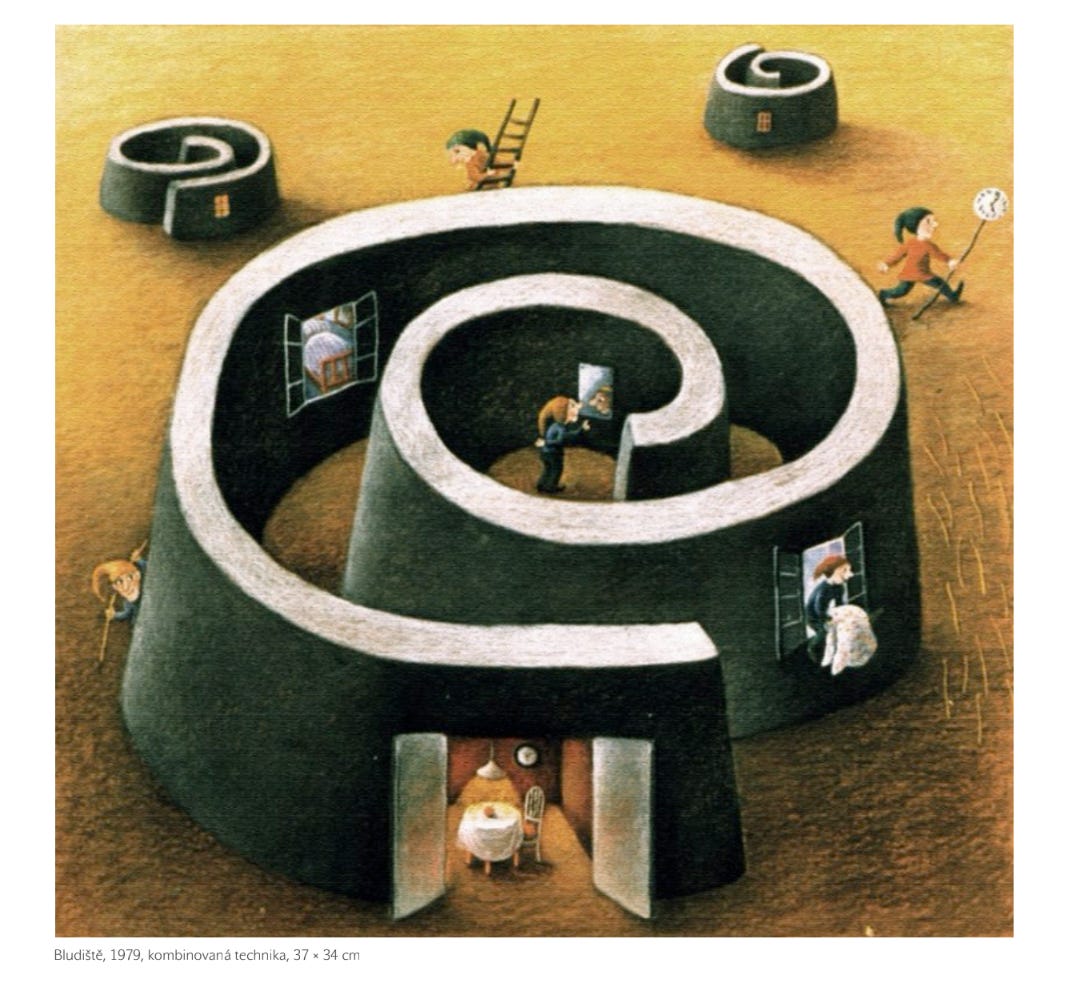
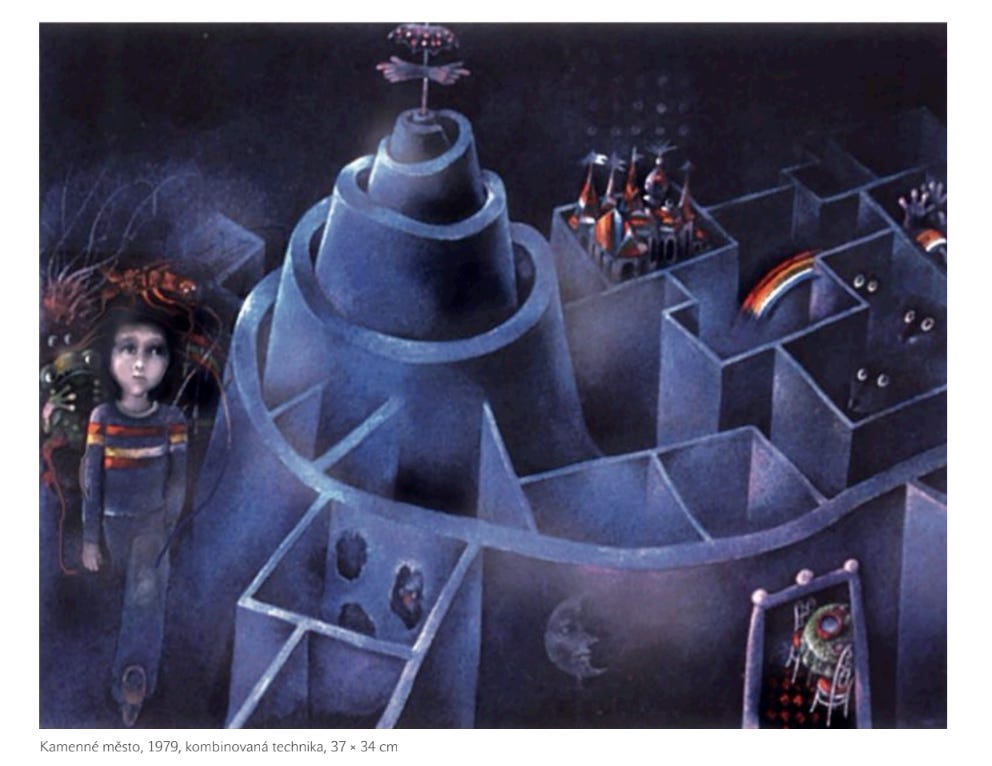
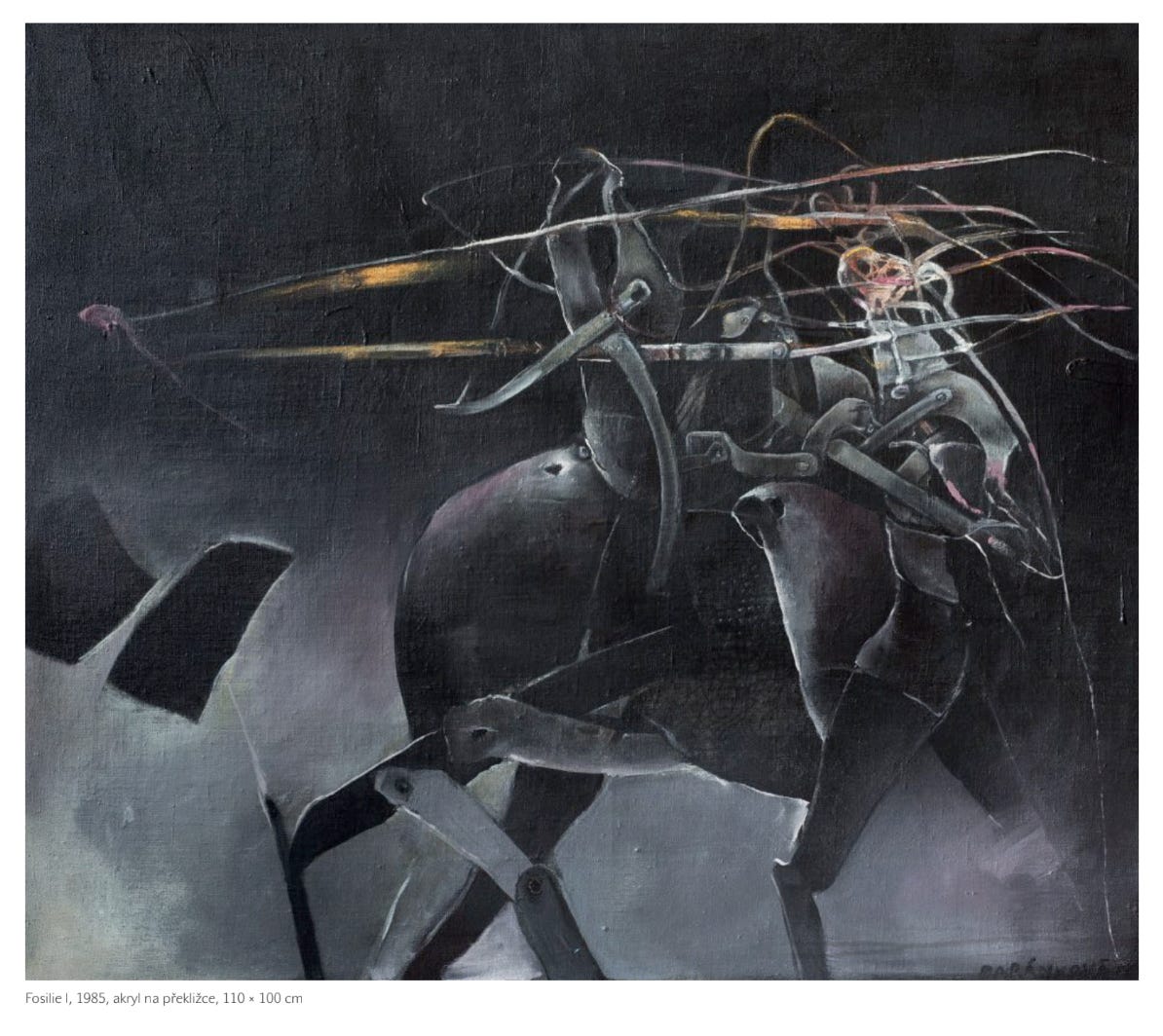
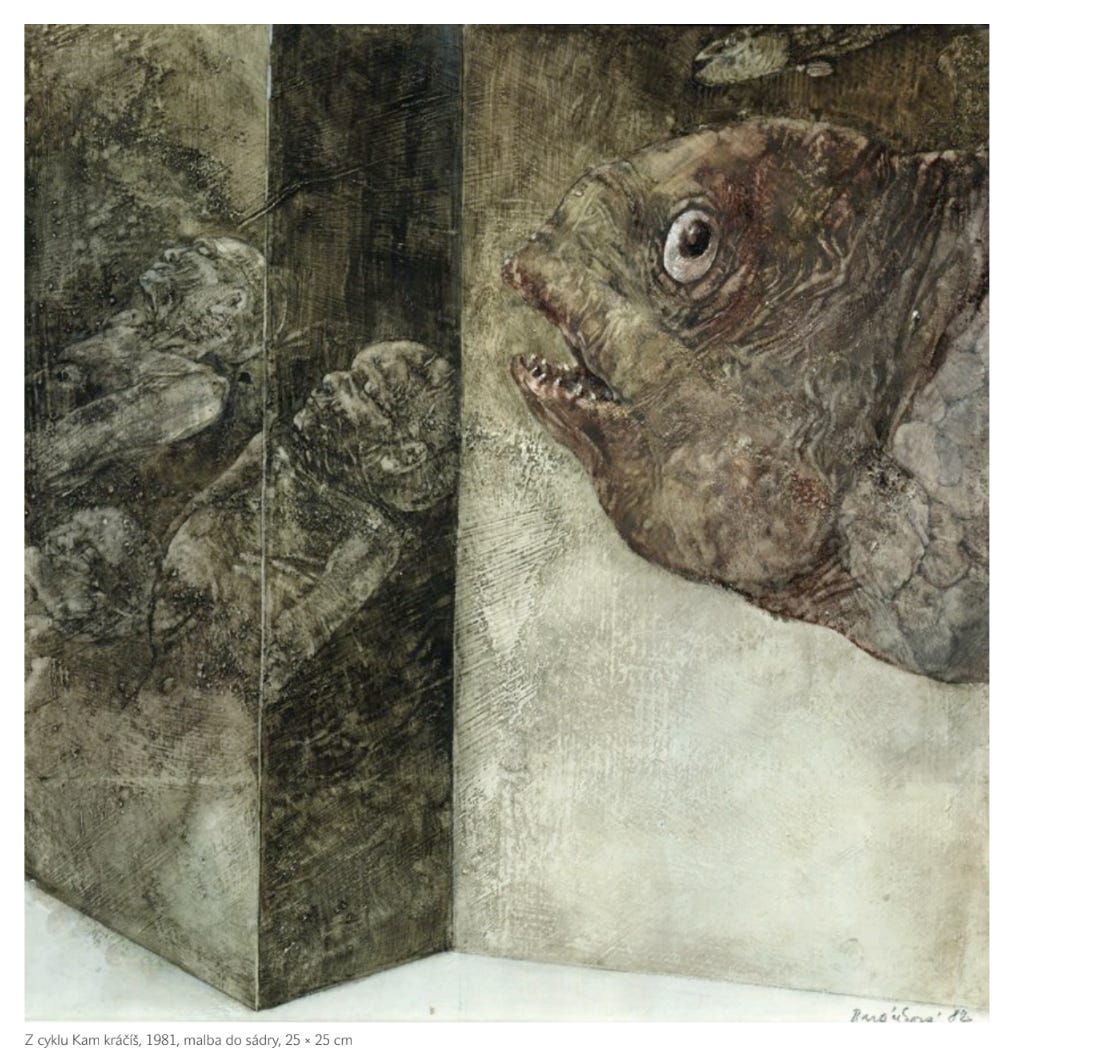
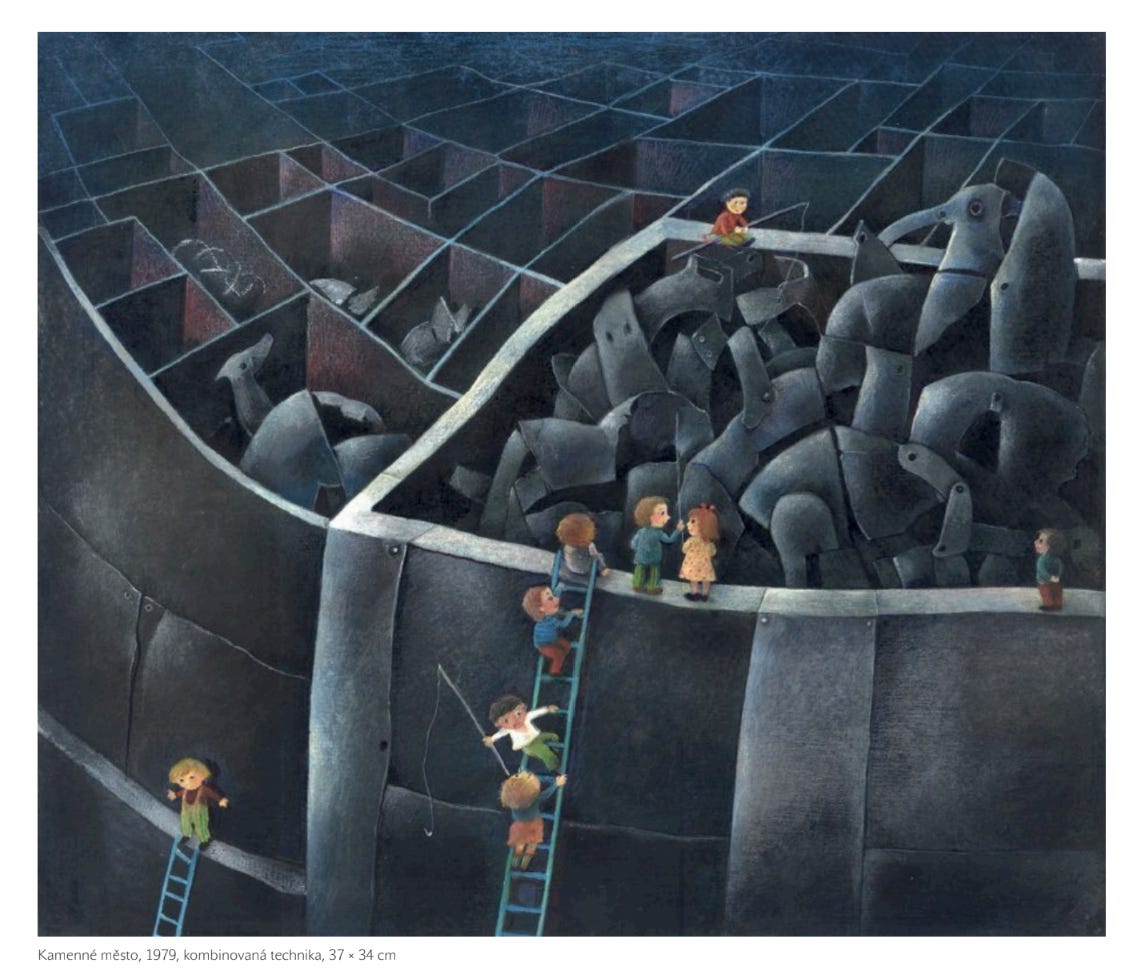
Sadly, Baránek’s mother Vlasta Baránková recently passed away, but through our correspondence he shared with me her book of gorgeous and haunting artwork—she was an accomplished artist and illustrator of many childrens’ books, including some I’m sure I read as a child. Tomáš also shared with me that she had to maneuver around communist-era restrictions in order to publish her work. As he observes, “this is how real artists and creative people live and die. They cannot help themselves, they enjoy the creativity and its painfulness.”
Indeed. And you will see that creative beauty and pain reflected in the work of Vlasta Baránková, who’s work I share here with permission. She may be gone, but her exploration of the human spirit remains with us. I grieve with you, Tomáš, but I am so grateful to know of your mother and the contributions she made to our shared humanity.



The performance-versus-learning question is one that educators grapple with regularly, of course, and it helps explain why so many get irritated by certain forms of standardized testing.
Just to nerd out on chess a bit more, there’s multiple variants of the game that further test human cognitive flexibility (and often proved harder for AI-driven engines to dominate). Here’s one fun example of such a game involving, yes, Magnus Carlsen.
Thank you, Ben, for your deep essay and for sharing my mother's artwork.
Ben - I enjoyed this and, as someone who sees both the limitations and benefits of LLMs (it's terrifying the think that, if LLMs are mostly a detour on the way to some kind of more advanced intelligence, what that's actually going to actually look like), I'm curious if you read a recent critique on the stochastic parrot paper that's making the rounds:
https://www.verysane.ai/p/polly-wants-a-better-argument
I don't pretend to understand all the ins and outs, but I found this more convincing than the original paper and I've listened to Emily Bender on a podcast and I have to say I was not impressed. Continued insistence that LLMs cannot do certain things in the face of evidence to the contrary makes it easy to tune out skeptics. That said, a lot of what happens under the hood of these models is certainly not what most users think is happening which is what makes conversations between users and non-users and tech folks and lay folks so challenging. Last thought - on the measurement side, I think the researchers shy away from the "human" stuff because they just don't know how to measure it. For the chess example (and I think of the Alpha Go example from a number of years ago), it does seem like the AI models and humans are playing different games and, on a technical level, I read the report as claiming humans cannot beat the AI's as the rules are currently written which seems to be unequivocal. I get that your argument is humans play for different reasons, but how does a research paper go about measuring that?