

Today I’m publishing my seventh report on Alpha School, one focused on its student motivation practices, along with a bevy of other new reporting — interviews of a former student and two former guides, plus observations from an educator who visited Alpha School in Austin last year, oh and also a cease-and-desist letter from my attorneys to Alpha School.
Here’s a quick guide to what’s new as of today (October 14, 2026):
SEVENTH REPORT: Student motivation at Alpha School and the “Alpha Motivation Lab” — This report examines student motivation at Alpha School in connection to Dr. David Yeager of UT-Austin, a leading researcher on motivating young people. Alpha School claims that it incorporates motivational techniques that arise from Yeager’s leading work in this field. In reality, however, Alpha School does not follow Yeager’s methods in the slightest, and instead employs an entirely extrinsic method of rewards and punishments. Alpha School is perpetuating a charade — and it is unclear to what degree Yeager may be helping them to do from his perch as co-founder and scientific director of the Alpha Motivation Lab.
You’ll find this report below.
Interview of Rhett Jones, former Alpha School student (class of ‘24) — Rhett Jones is arguably Alpha’s most prominent alumni, someone held up as proof of the success of its model. Unexpectedly, Rhett contacted me a few weeks ago of his own volition, and told me that while he supported my work, he also objected to aspects of my reporting. Demonstrating an admirable courage that I’ve yet to see from Alpha School’s current leadership, he agreed to speak with me on the record about his experiences. I found our conversation fascinating and I suspect readers will as well.
Interview of Calie Garrett, former Alpha School guide (2025) — Calie worked as a guide at Alpha School from July 2025 to December 2025 in Alpha School’s pre-K to 5th grade program. A veteran educator who worked in Title I public schools with students with special needs, she did not mince words when describing Alpha School’s academic program: “It’s death on a stick.” She explains what that means in our interview, and discusses many other disturbing aspects of Alpha School’s culture that she experienced.
Observer of Alpha School’s Austin campuses in Fall 2025 — This report features observations from veteran educator who in Fall 2025 arranged a visit to Alpha School’s lower grade school and high school in Austin. She learned a great deal, though not in the vein she expected — in her words, “something felt very, very wrong.” This report also features pictures from her visit.
Interview of a former Alpha School guide (2019 to 2021) — This interview features a source who worked as a guide at Alpha School from Spring 2019 to Spring 2021, and was part of the team that helped establish Alpha School’s founding high school, which commenced its operation in Fall 2019. Regarding Joe Liemandt, the man who controls Alpha School, they said this: “I don’t think I’ve ever encountered anyone who just seems to have a total lack of empathy about them.”
Cease-and-desist letter to Alpha School — Throughout my reporting, Anna Davlantes, Alpha School’s Chief Communications Officer, has failed to respond to a single email I’ve sent her. But she has been talking about me. As my attorneys write, “on at least two separate occasions, she has directly made false and defamatory statements of the most disgusting kind, first to a news reporter and later to an opinion columnist,” statements intended to smear my character and chill my reporting. Not only have her efforts failed, she and Alpha School have now been put on notice that if their defamatory conduct continues, we will sue.
Rather than bombard my readership with multiple newsletters, with the help of a friend I’ve created a new sub-page on the Cognitive Resonance homepage, labelled THE ALPHA FILE. Going forward, this will be the repository for my investigative reporting into Alpha School. I recognize some readers are suffering Alpha fatigue — boy do I know the feeling! — so rather that push out every new report via email, I will periodically inform you of what’s been posted to this sub-page, should you want to read my latest findings.
While I plan to maintain my investigatory focus on student life at Alpha School, and in particular the physical and psychological harms that stem from Alpha’s pedagogical practices (if they can be called that), going forward I plan to start moving up the ladder of responsibility to examine Alpha School’s leadership, and how it’s inculcated the abhorrent culture that exists within Alpha today.
My investigation will continue until the reality of Alpha School is fully brought to light.

SEVENTH REPORT: Student Motivation at Alpha School and the “Alpha Motivation Lab”
The troubling relationship of Dr. David Yeager, co-founder of the “Alpha Motivation Lab,” with Alpha School, the Liemandt family, and MacKenzie Price

This special report examines student motivation at Alpha School and its connection to Dr. David Yeager of UT-Austin, a leading researcher on motivating young people and co-founder of the Alpha Motivation Lab.
As you will read, Alpha School claims that it incorporates motivational techniques that arise from Yeager’s leading work in this field on cultivating healthy mindsets for intrinsic self-driven improvement, with the support of caring adults as mentors. In reality, however, as my reporting both today and previously reveal, Alpha School does not follow Yeager’s suggested methods, and instead employs an entirely extrinsic method of rewards and punishments to drive student motivation. Alpha School is perpetuating a charade — and it is unclear to what degree Yeager may be helping them to do so, because he serves as co-director of the Alpha Motivation Lab, and has extensive ties to its leadership.
This special report is organized as follows:
Student motivation at Alpha School
Dr. David Yeager and the “science of motivating young people”
Yeager’s ties to Alpha School via the Alpha Motivation Lab
Yeager’s ties to the Liemandt family
Yeagers’s ties to MacKenzie Price
My commentary
Let’s dig in.
Student motivation at Alpha School
We start with the reality of how Alpha School motivates its students.
Concurrently with this special report, I am publishing interviews with two former Alpha School guides, and one recent observer of Alpha’s Austin campuses. All of them state unequivocally that when it comes to motivating students to learn at Alpha School, as well as Joe Liemandt’s personal beliefs, extrinsic motivation rules the day:
Regarding Alpha School, it’s “all reward based, literally paying students. Nothing for personal satisfaction, or the pursuit of intellectual achievement.” — Former guide
Regarding Joe Liemandt, “his argument was that there is no such thing as intrinsic motivation. Everything is extrinsic.” — Calie Garrett, former guide
“One young child, who I believe was either a first or second grader, refused to focus on her computer for two hours — clearly, she wanted to move around and interact with other kids, and was growing very frustrated, and started to be non-cooperative. In response, her ‘guide’ placed her in what looked like a phone booth, alone, and closed the door.” — Alpha Observer
These statements align with every single source I’ve spoken to regarding motivation at Alpha School. Without exception, they have described a school culture and pedagogical approach wherein everything is based on obtaining rewards and status (e.g., the Rocket Ship), or else having certain privileges taken away (e.g., the Pirate Ship), as described in my prior reporting:
“I was in the Pirate Ship. We got kicked down grade levels, and we had to work our way back up. We were completely shut off from the rest of the students. We had completely different privileges…Some students never got out of the Pirate Ship.” — Former student
Regarding the so-called Rocket Ship, students in it “had certain rooms they could go in without asking. The regular students could not go in them. So they pretty much segregated these higher students, and they had more privileges.” — Former student
“I think Alpha School students are being punished by rewards. They’ve set up a system where you do things to get something tangible. [But] at Alpha, students are purchasing smartwatches with their alpha points.” — Alpha Observer
In contrast, not a single source I’ve spoken to in the course of my reporting has described Alpha School as cultivating intrinsic motivation with students. Motivation at Alpha School instead looks like what we see below — students must “earn Alphas” for meetng their “XP” so as to “unlock Legendary Lion Status” to get snacks and other privileges1:

This is as extrinsic as it gets.
David Yeager and the “science of motivating young people”
Within the education field, there is extensive research and debate regarding the respective roles that intrinsic versus extrinsic motivation should play to motivate student learning. In practice, it’s fair to say that many schools strive to develop intrinsic self-driven motivation in students, while also pragmatically employing extrinsic rewards to some degree. Few would object to a teacher giving out stickers to students as a prize for finishing a simple task, or throwing a pizza party if the class reads some total number of books. (The latter seems unlikely to happen at Alpha School.)
But far less common nowadays is using extrinsic punishments to motivate students — the days of students being rapped on their knuckles with rulers are long past. With good reason: This recent meta-analysis of more than 223,000 students found that motivation based on avoiding punishment was not associated with academic performance or persistence, but was associated with diminished well-being. A great deal of recent research accords with this general finding. Put simply, when using extrinsic motivational techniques, research (and common sense) favor the carrot over the stick.
And regardless whatever one personally believes about any of this, scientists are obligated to follow the data. This brings us to one of the major contributors to the scientific literature related to adolescent motivation: Dr. David Yeager, a professor of psychology at UT-Austin, and someone who did his graduate work under Dr. Carol Dweck (she who is famous for “growth mindsets”).
Yeager is an academic star, in my view someone who has long conducted high-quality empirical research within social psychology, and is considered one of the nation’s leading experts on adolescent motivation. When I led an education nonprofit organization that worked to improve teacher preparation, his work informed my thinking, and by extension our programmatic work.
Among other things, Yeager recently authored the book 10 to 25: The Science of Motivating Young People. Last week, I picked up a copy from the Austin Public Library to refresh my understanding of Yeager’s perspective on motivating young people. Here are some statements I found noteworthy in 10 to 25:
“Before a [young person] can hear criticism for what it is — helpful advice on how to better meet their goals — they have to feel safe.” (p. 5)
“Adults tend to present young people with two sorts of rationales for learning: short-term self-interest and long-term self-interest. Short-term self-interest can take the form of an enticement…or a threat, such as, If you don’t do this, then I’m going to yell at you or embarrass you or punish you.” Yeager goes on to state that this is unlikely to be effective. (p. 206)
“Human beings have a basic need to belong and be accepted…Unbelonging can be as serious to adolescents as a threat to maternal attachment to a baby. Thus, even seemingly minor experiences that make a young person feel like they’re a poor social fit for a group or setting can make them feel like a poor intellectual fit and scare them off.” (pp. 229-230)
“In general, I think most parents [and] teachers…want to promote inclusive excellence [] rather than exclusive excellence — allowing only a tiny, well-resourced few to reach a high standard.” (p. 260)
Or as one review in a Canadian periodical puts it, Yeager “explain[s] how motivation is shaped by brain development, identity formation, relationships, and a growing desire for autonomy and purpose…he questions our overreliance on external rewards and consequences, offering evidence-based strategies that foster intrinsic motivation through trust, meaning, and connection.” (My emphasis)
All this accords with what I’ve long understood to be Yeager’s general academic project At heart, he believes in the power of self-driven improvement by cultivating the right mindsets, carefully fostered by strong human relationships — much of 10 to 25 is about effective mentoring — and throughout his career he’s conducted high-quality research that has empirically validated this perspective. His position, if I’ve understood it correctly, appears to be diametrically at odds with Alpha School’s wholly extrinsic pedagogy, and especially with respect to Alpha’s use of punishments and “othering” of students that struggle academically — e.g., the Pirate Ship.
It is therefore striking, perhaps even shocking, to discover that Yeager has multiple ties to Alpha School, the Liemandt family, and MacKenzie Price.
I turn to these ties now.
Yeager’s ties to Alpha School via the Alpha Motivation Lab
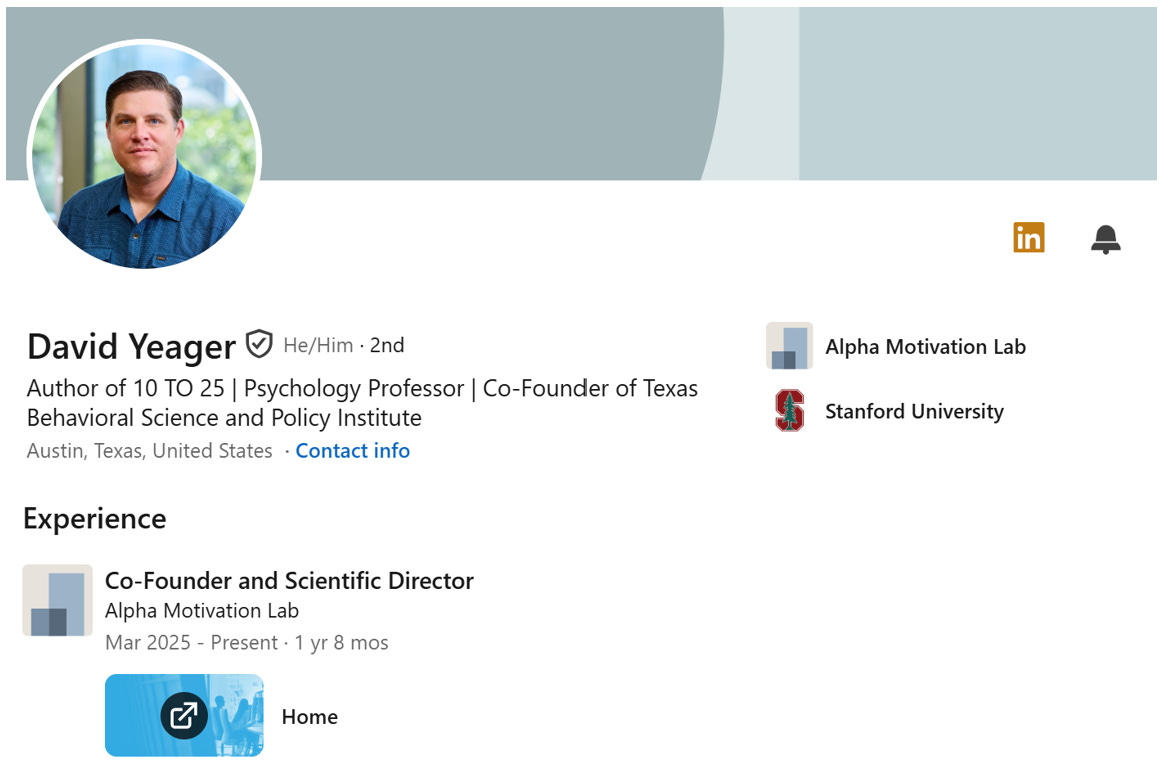
Yeager’s LinkedIn profile lists him as the co-founder and scientific director of the “Alpha Motivation Lab.” The lab’s website can be found here, and it states that it is “the premier scientific organization for the study of motivation.” The website identifies three people as co-directors: Yeager, Meghann Johnson, and Megan Smith. Although Yeager and Johnson both have academic affiliations with UT-Austin, the lab is housed elsewhere as “an independent research organization operating as a fiscally sponsored nonprofit partner project of the National Center for Civic Innovation (NCCI), a nonpartisan, nonprofit 501(c)(3) organization formed by the Fund for the City of New York (FCNY).”
In preparing this report, I asked Yeager to explain the organizational structure of Alpha Motivation Lab. He told me this: “Alpha Motivation Lab is housed at a non-profit fiscal sponsor, like many other research entities..[I]n general the Lab has a different purpose and does different kinds of projects than a university-based lab, and so it is not suited to be housed at the university.” He further flagged that issues around intellectual property and HR can be complicated within a university structure (very true from my own professional experience). Finally, he noted he maintains a separate research institute at UT-Austin, “which has its own agenda and funding.”
So far, so good — all this seems reasonable, at least to my eyes. But there remains a puzzle. Last year in August 2025, an entity named “2HR Learning, Inc.” filed for trademark registration of the name “ALPHA MOTIVATION LAB.” Then, just a few weeks ago in September 2026, “Timeback, Inc.” filed to trademark “ALPHA MOTIVATION LAB,” and this mark was assigned to it from 2HR Learning.
As I’ve reported previously, TimeBack is the rebranded name of 2-Hour Learning, Alpha School’s core software product.
Asked to explain these trademark filings, Yeager told me this: “[Alpha Motivation Lab] is technically owned by NCCI—it is just an account in the fiscal sponsor. The trademark app should have said the owner is David Yeager or NCCI. We’re working with the lawyer to figure out why that wasn’t the case. Thanks for pointing that out - we hadn’t noticed that in the filing because we got the trademarking legal help from outside counsel before we were established at NCCI and had access to NCCI’s counsel.”
There are at least two issues with this explanation. First, Yeager’s response might explain the initial trademark filing by 2HR Learning last year when the lab was in its relative infancy. Yet, less than one month ago, Timeback Inc. was assigned the trademark, which it presently owns. Second, “outside legal counsel” here appears to be Brian Spross of Jones and Spross, a law firm based in Austin — he’s listed on the Timeback, Inc. trademark filing as the “trademark correspondent.” According to Spross’s online bio, he “acts as an outsourced general counsel for many of his clients, having begun his career in-house at Trilogy Software/Versata…” Notably, Trilogy Software/Versata is owned by Joe Liemandt.
Returning to the Alpha Motivation Lab and its research aims, Yeager stated the following, which I reprint in full:
We don’t have any projects with Alpha school or time back or any other of those entities; we haven’t conducted research on their efficacy or impact; and we wouldn’t do so any way because we don’t do evaluations of specific programs or school models, unless it would be new interventions that we’ve created, and we’re testing whether our ideas work. We are a wholly separate entity from Alpha School, and we look at broad questions of motivation that we hope have wide implications for schooling and learning; If these questions help Alpha School or any other school do their work better, that’s great, but we don’t conduct research for any specific organization or on any organization’s program offerings or methods.
When we work with a client on contract, we limit our evaluations to questions of whether new features or new components can improve the product’s offerings, but we refrain from questions about whether the whole thing is effective, because our goal is not to endorse or condemn any specific organization or product.
Note again that we don’t have any contracts with Alpha School or any active projects on product or offerings or features; we have contracts with other non-profit entities. As a scientific organization we also limit our official statements and evaluations to studies the we have conducted or know intimately.
I will return to this statement shortly.
Yeager’s ties to Liemandt family
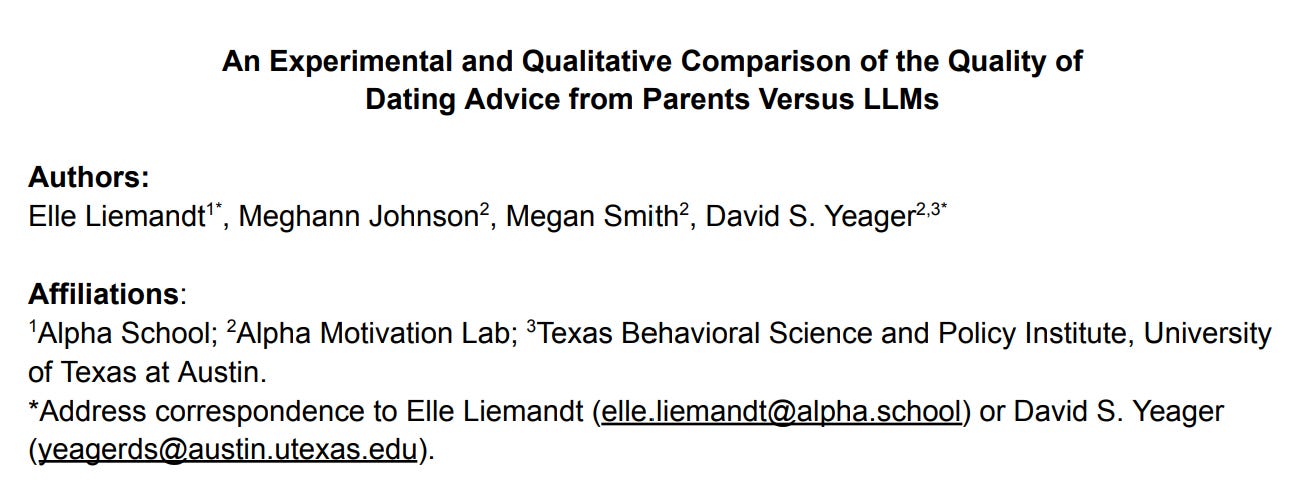
In November 2025, Elle Liemandt — the younger daughter Joe Liemandt, the man who controls Alpha School — co-authored a research pre-print paper with Yeager, Johnson, and Smith about providing quality dating advice to adolescents. She is listed as the paper’s lead author, as you can see above.
As part of this study, research was conducted using a “fine-tuned and prompt‑tuned conversational model designed to give teen‑appropriate relationship advice” called “AskElle.” The author contributions section states that, “[Elle Liemandt] and [David Yeager] conceived of the study, designed the pre-analysis plan, and wrote the paper. [Elle Liemandt] developed the research questions and hypotheses, led the creation of stimuli, helped modify the IRB protocol, conducted the literature review, wrote the first draft of the paper, and led the qualitative analysis.”
In preparing this report, I asked Yeager to clarify Elle Liemandt’s role in this research. He confirmed what is stated in the contributions section, and added: “It was remarkable work, led by her. She did more than some first authors on previous papers my lab has published. Very impressive for a high schooler.”
Indeed. Notably, however, the competing interests section of the paper also states: “[Elle Liemandt] developed the AskElle app as a school project at Alpha School and therefore had a financial stake in the outcomes of the research.”
Outside the Alpha School high school campus in Austin, there is a promotional video that is played on a loop with the audio broadcast on public speakers, so passers-by on the street hear students describing their experiences at Alpha. With apologies for the poor audio quality, in this clip that I recorded on Sunday October 11, 2026, you will hear the following statement: “I’m going to build a safe teenage dating app for millions of students that makes a billion dollars. My name is Elle Liemandt.”
The competing interests section of the pre-print then goes on to state: “Alpha Motivation Lab received financial support from the Future of Education, LLC, which also financially supports Alpha School.”
What is the Future of Education LLC? The Texas Observer has reported that in 2023, one day after its legal formation, it made a $1 million political contribution to Glenn Youngkin, then the Republican Governor of Virginia and someone whose political star was on the rise (but perhaps no longer). The Texas Observer further reported that, “the address for Future of Education LLC listed on the Virginia public record of the donation is a home that, according to Travis County records, is owned by Andrew Price and his wife MacKenzie Price.” The Future of Education is also the name of MacKenzie Price’s podcast.
So I also asked Yeager to clarify what the relationship is between Alpha Motivation Lab and Future of Education LLC, whether he knew about the Price family’s control of it, and whether this created a conflict of interest with the research the lab conducted. Although he didn’t answer this question directly, he did provide the statement in the callout box above.
In that statement, Yeager asserts that the Alpha Motivation Lab does not “conduct research for any specific organization or on any organization’s program offerings or method,” and that “we don’t have any contracts with Alpha School or any active projects on product or offerings or features; we have contracts with other non-profit entities.”
After Yeager provided his statement, I followed up with this: “The research you conducted with Ellie Liemandt was funded by Future of Education LLC. Is this one of the non-profit entities you are referring to? Can you explain the relationship AML/NCCI/You had with Future of Education LLC that funded the work you did that produced the pre-print Elle Liemandt co-authored?”
He did not answer any of these questions.
Yeager’s ties to MacKenzie Price

In October 2025, Yeager participated in an event with MacKenzie Price titled “From Inspiration to Action: The Mentor’s Guide to Ignite Motivation” that took place in Santa Barbara, California. In connection with this, Alpha School offered workshops to parents that purportedly would explain how to “use rituals and routines to spark intrinsic motivation.” (Sources tell me at least two other Price-Yeager parent-facing events took place around this time, one in NYC and the other in Austin.) On LinkedIn, Price has described Yeager as “her friend,” and said that parents who attended the Santa Barbara event would “learn how you can turn his research into real-world steps you can use to help kids thrive.” And she further claims every Alpha high student has to read his book.
Right. Now for some backstory.
I’ve known David Yeager for many years, and as mentioned earlier, his academic research informed my thinking about student motivation in the context of teacher preparation. I was therefore surprised when, about a month ago and in the course of preparing my first special report on Alpha School’s boot camp, I discovered the page on Alpha School’s website describing this collaboration with MacKenzie Price and the event in Santa Barbara. So I reached out to him directly to give him a heads up regarding what I planned to report — in essence, to warn him about the reality of Alpha School that I was uncovering. We spoke briefly, and off the record.
Fast forward to last week. Given my new reporting on what former guides describe as the extensive use of extrinsic motivation techniques at Alpha School, I reached out to Yeager again (via email) seeking comment in response to what these sources described.
He replied: “Thanks! I just got back from being out of the country and don’t think I can give this the time it deserves for your deadline. I’d be happy to talk in the future about some research questions we think are really interesting on these topics.”
I expressed my disappointment in his non-response response, extended the comment deadline for another three days, and provided additional information regarding Alpha School’s emphasis on extrinsic motivation. In a follow-up email I stated, “I have yet to hear you address in any way the specific facts about how Alpha School is motivating students through extrinsic rewards. Alpha School markets itself as inculcating intrinsic motivation by direct reference to their affiliation with you. Not a single source — not one — agrees that is happening, or has ever happened, at least since Joe Liemandt assumed control of Alpha School.”
On October 8th, Yeager responded to my inquiries regarding the organizational structure of Alpha Motivation Lab and Elle Liemandt’s research role, and his reply to those points are included above. But he once again failed to respond to anything related to what I’ve reported about Alpha School’s system of rewards and punishments, such as segregating students into different rooms. So I pressed him again via email:
You still have not responded to any of the facts I’ve produced in my report regarding the segregation of children at Alpha School into rocket ships and pirate ships, or the quotes I provided you regarding the near-total use of rewards and punishments to extrinsically motivate students. Why not? What is your position on these activities? Do they accord with your beliefs about how to motivate students?
On October 9th, Yeager responded to some of my inquiries regarding Alpha Motivation Lab’s legal structure, as noted above. But once again he declined to respond to my reporting on Alpha School’s motivational practices. He asked me instead to delay publication of this report for at least a week so that we might have a “lengthier discussion without time pressure,” though even then he did not firmly commit to responding to the questions I’ve posed. Having already extended the response deadline for several days, I declined his request, but I offered to update this report if and when he decides to respond to the specific motivational practices of Alpha School that appear to conflict with his research.
That offer remains open.
My commentary
It’s pretty obvious what’s going on here.
Since intrinsic motivation appears entirely absent from the Alpha School student experience, both historically and at preset, it seems clear that Alpha School, Liemandt, and Price are communicating externally that they embrace the intrinsic techniques that Yeager champions, while in reality they employ the most pure version of extrinsic motivational methods — and grim punishments — that I’ve seen in my two decades working in education.
It’s a snow job, and while I totally get why Alpha School’s leaders are doing it, the question is why David Yeager appears willing to go along with their charade. It’s possible he and the co-directors of the Alpha Motivation Lab have been deceived into thinking that intrinsic motivation techniques are being used at Alpha School; I myself had little insight into the dark pedagogy Alpha School has been practicing until I started my investigation.
My reporting, however, now puts the lie to the tale that Alpha School leadership has been telling the world. Students are not intrinsically motivated at Alpha School. That’s just not a thing its leaders care about. The activities of Alpha School are always in flux, not to say turmoil, but if there’s one constant throughline since Joe Liemandt took over, it’s that rewards and punishments will be used to force students to use its software, and to motivate student behavior more broadly.
But is Yeager really unaware of what’s going on? The name of the Alpha Motivation Lab itself, along with the use of “outside counsel” to trademark the lab’s name who once served as general counsel to Joe Liemandt’s software company Trilogy, along with the fact that the lab received funding from the same LLC that was used by the Price family to make political contributions to Glenn Youngkin, along with the lab co-authoring a paper with Elle Liemandt connected to her “AskElle” dating-advice app that she proclaimed would make a billion dollars, all suggest Yeager is deeply entangled with Alpha School and the broader Liemandt family empire. Yeager thus appears to be putting his heretofore sterling academic reputation on the line to advance the interests of Alpha School and the Liemandts and MacKenzie Price, even though they embrace motivational methods that violate just about everything I think — or at least thought — he stood for.
I find this very troubling. Having founded and led an education nonprofit for a decade, I’m no stranger to the ethical dilemmas of taking money from unsavory donors — as my board chair once said, “sometimes we take money from bad people to do good things.” But what Yeager appears to be doing goes far beyond that — Alpha School is using him and his academic reputation to cloak their abhorrent practices, and he seems to be going along for the ride to get funding for his research. I mean, six-year-olds being placed in isolation booths because they don’t want to use a computer for two hours, my god.
It’s inhumane.
I’ve presented Yeager with clear evidence of these practices, but in response, he’s obfuscated and handwaved it away without meaningful comment. Parents may — emphasis on may — get to choose to place their children into the educational dystopia that is Alpha School, but scientists are not supposed to turn a blind eye to evidence that’s in front of them. There’s a larger story to be written about the unholy nexus between billionaire donors and research funding, but in the here and now, Yeager should be explicitly and publicly disavowing what Alpha School is doing to extrinsically motivate children through rewards and (especially) punishments. That he’s chosen silence instead speaks volumes to the corrupting power of money in academia.
The Alpha Motivation Lab is now an active focus of my investigation.
“I was born in 1923, a very different time that we read about. People are thinking in terms of the slow economy and the changes people need to make. I am confident that it will be good, for our well-being is not dependent on what one possesses.
I remind us each one: ‘The love of money is the root of all evil.’”
— Tempa Riley, my grandmother, in an email sent to her grandchildren during the Great Recession
As reminder, “XP” is how Alpha School tracks successful use of its TimeBack software. In lower grades, for example, students must earn 120 XP per day, corresponding to the aspirational goal of them hitting 1 XP per minute of use (two hours in total). “Alphas” is the cash money benefit that Alpha School pays students for hitting their XP. Finally, the “mobile squad” refers to additional privileges or rewards that students can vote on and obtain for meeting XP-related goals — such as taking a trip to the local mall for a shopping spree, as one source told me.
Keep at this please. I do think educators in every other model of education, including in-person government public schools, can learn something from the Alpha School model.
But it's incredibly difficult to parse through the PR for a company that wants to scale, and therefore invests appropriately in reputation management, etc, as a for-profit business generally does, and arguably, should do to maintain positive affinity with a client base.
There's a key sticking point, though. Like the note from your grandmother, how much does education need to be monetized further? If someone's answer is "fully, cut public education, make it just a lump sum and you spend it on what model is best"...for their sake, your work is super important.
Every schooling model has flaws, even unschooling or homeschooling or micro-schooling. That's fine. Hiding them is not.
Thank you again for not taking your finger off the pulse. Now if these "experts" would just be responsible enough to look into these allegations instead of just hiding behind "They told me everything was ok."