


I am very pleased to share this guest essay by Alicia Stoller, who writes the wonderful newsletter Notes on Hope that explores “cultivating a courageous form of hope in worried times,” often through the lens of education. Alicia was a preschool teacher for 10 years, and later a preschool director and graduate school instructor. Nowadays, she consults on education and parenting and child development, and she’s also a NYC public school parent.
I hope you find this essay as inspiring as I do.
Reclaiming a Vision of Humane Schooling
by Alicia Stoller
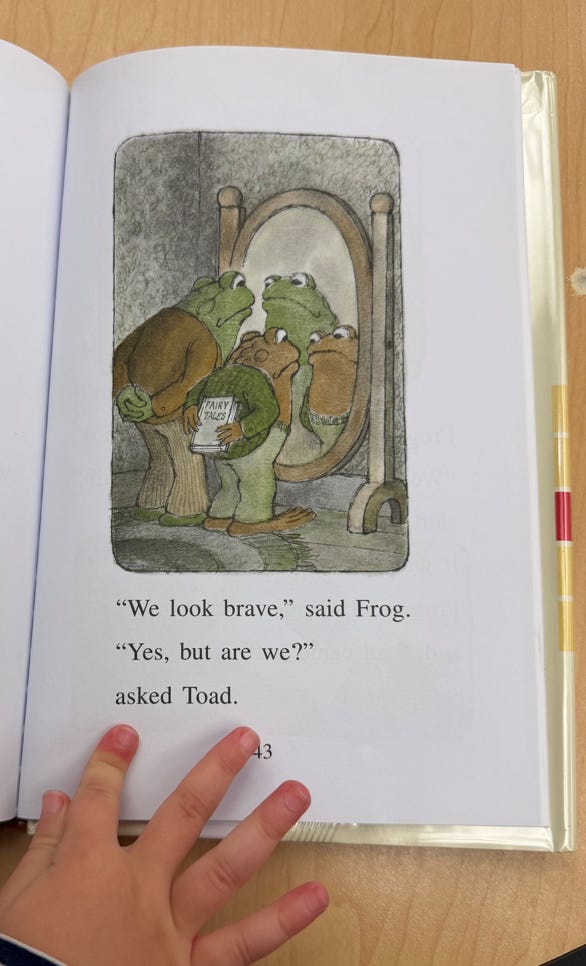
In January of 2021, as we emerged from the darkest phases of the pandemic, the rabbi and climate activist Shoshana Meira Friedman wrote about the challenges of raising children with love and hope amid so much loss. When her toddler son, who had fallen in love with nature while the world was shuttered, learned that a grove of hemlock trees he’d named “Frog and Toad’s Corner” was dying, Friedman wrote:
“I could scarcely breathe, startled by the sudden clarity that I am teaching my child to love a dying and transforming world, that he will learn to love and lose in the same breath, and that I will learn along with him.”
As our devices buzz against our skin each day, warning of one potential existential threat after another, raising and teaching children has become laced with growing anxiety.
It is hard not to let these worries consume us.
The values that inform our teaching, indeed the purpose of education itself, also become more contentious during times of rupture. The function of education is typically defined by the dispositions and skills that adults believe children will need to thrive in an imagined future. On its face, this makes sense. If the most basic purpose of school is to facilitate growth and to prepare children for adult life, it is logical to fix our gaze on what’s to come.
But when fear overwhelms us, preoccupation with the future can become a trap. And in trying to protect our children, we may find we’ve forfeited their childhood.
Pervasive fear of the future also creates openings for predatory versions of school, built to profit off our anxiety. When we view education solely as armor that will protect our children from hardship or scarcity, we risk sacrificing their full humanity today, and the possibility of a less dire tomorrow.
But, like Friedman’s son hugging his beloved hemlock trees, children deserve the fullness of the present. So what might it look like to reject fear, and instead reclaim a humane education that insists upon the dignity of our children today, and the possibility of a more hopeful tomorrow?
Here is what I think it will require.
Step 1: Unmasking the Wolves

Having spent over two decades in both independent (private) and public school classrooms, as a teacher, a school leader, a student-teaching advisor, an educational consultant, and a parent, I have found that most schools espouse similar values. They are the words that flash across school websites and emblazon bulletin boards: curiosity, creativity, compassion, resilience, wonder, love of learning, and student agency, to name just a few.
In many schools, these values are deeply lived, as teachers model them and bring them to life for students each day. Sometimes, though, articulated values only serve to provide a virtue-signaling haze meant to obscure less virtuous goals — usually some external profit or power.
The history of education is littered with examples of children being used as cover for such schemes. This would not be possible if the engineers of these efforts flatly admitted that they don’t really care about children. So, like the wolf in the fairy tale, they disguise their intentions in words we trust. We are seeing examples of this now in ed-tech companies that claim to be guided by notions of literacy, while actually cultivating future consumers, and in schools that claim to nurture innovators, while actually fostering acceptance of predation.
Alpha School, for example, asserts that its educational model is “designed for joy.” Its website declares that instilling “a lifelong passion for learning,” and ensuring that “every student feels valued and motivated” are core values. The rift between these stated values and Alpha School’s actual teaching practices is jarring. Monitoring a student’s heart rate while they are publicly criticized by their parents, or using software to track and correct a child’s emotions, does not instill joy or make kids feel valued. I suspect that the parents who have been drawn into these schools are compelled, at some level, by their own fears of an uncertain future; the only explanation for turning school into “boot camp” is a belief that the path ahead will be combative.
Powerful people want us to believe that our kids’ survival depends on accepting callousness and inhumanity. But I am not willing to forgo our children’s dignity. Nor should any educator or parent.
Step 2: Reclaiming Humane Educational Values
Education is fundamentally an optimistic endeavor. As we work to contain the wolves, we need to articulate a more hopeful version of school. Here are a few anchor points for a humane vision of schooling that lives up to its stated values:
A joyous spirit of exploration
Yes, let’s start with sincere, authentic joy. Joyous classrooms begin with teachers who delight in the content of their curriculum, and in the minds of their students. Let’s nurture teachers who relish knowledge and revel in the questions, curiosities, and insights of children.A wild embrace of wonder and imagination
The deepest learning begins in wonder, not in the cold pursuit of achievement. Let’s cultivate classrooms that spark wonder at the human spirit and at the mysteries of the universe in equal measure: views of the stars, muddy adventures, and poetry that opens our students’ hearts and minds.A deep and abiding empathy
There is a reciprocal relationship between care and learning. Let’s look for invitations to empathy in every element of the school day — in the dilemmas of history, the journeys of fictional characters, the diverse vantage points of other beings in the natural world, and in students’ own connections with one another. Let’s fill children’s days with a kaleidoscope of perspectives. Empathy grows from frequent, meaningful encounters with diversity.A willingness to work diligently and with fortitude
Learning often requires persistence and stamina. But a tolerance for productive struggle doesn’t have to operate in opposition to joy, wonder, empathy, or a child’s own dignity. We can do this without stripping students of their self-worth. Let’s encourage students to grapple with challenging ideas and skills, motivated by their own drive and cheered on by our vociferous belief in their capacity.A tolerance for uncertainty & patience in pursuit of wisdom
Learning involves engaging with complexity, and uncertainty is often a sign that we are on the edge of wisdom. Let’s give students opportunities to sit with the discomfort of the unknown. And let’s offer them warm company in such times, so they know that adults are not immune to confusion or doubt themselves.Love for the world as it is, and as it could be
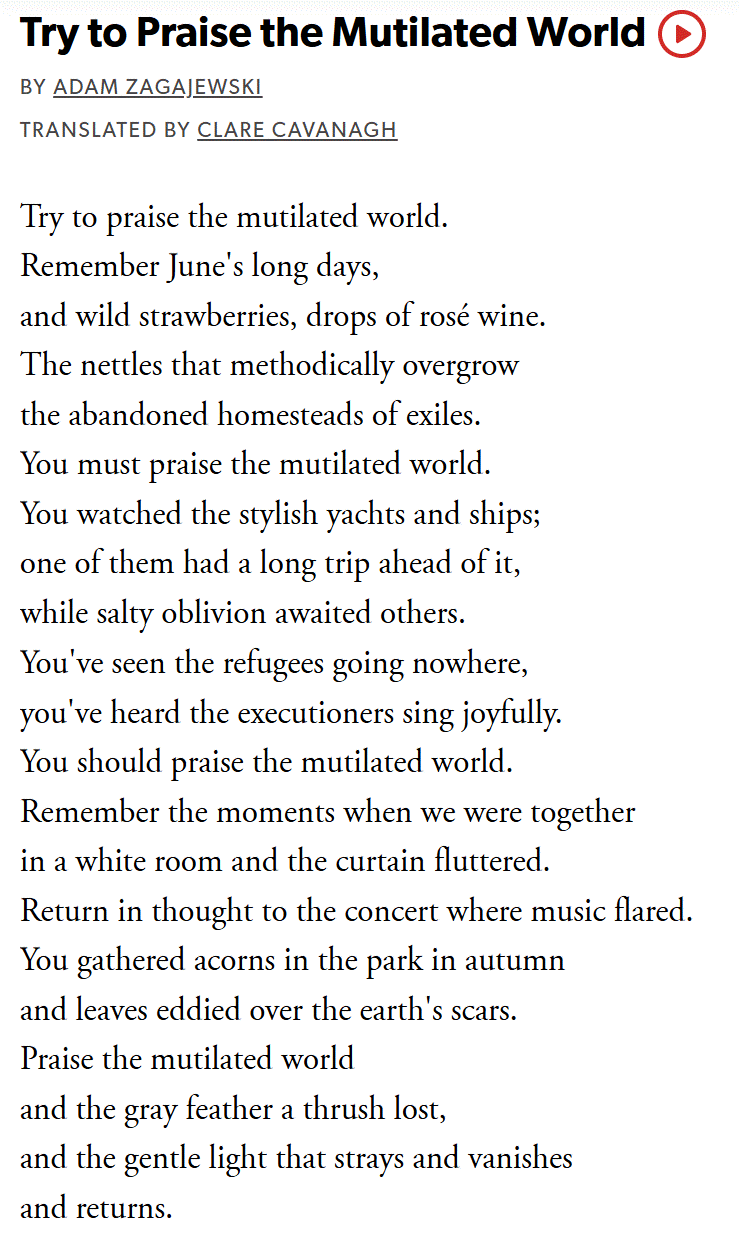
It is possible to learn about the world without loving it. But learning without love, even when love breaks our hearts, diminishes children’s humanity and abandons the full range of possibilities for their future. Let’s cultivate opportunities for children to hug hemlock trees, cradle oysters, gaze at Juliet on the balcony, and “praise the mutilated world.”
The way in which we value children as they stand before us instructs them in who they are permitted to become, and in the values they should uphold themselves. When our fear of the future obscures the beauty of a child’s developing, grappling, sensitive, inquisitive mind, it overwhelms their essential humanity — and our own.
We can do better.
Children are paying constant, close attention to the world around them. The values we espouse for their future are only credible when our actions, as the adults in their lives, bear those values out in the present. When we delight in the questions, curiosities, imagination, and even in the confusion of children, we stand guard against those who claim to speak for their future. We contain the wolves. And we give children back the right to imagine their own future.
As the poet Mary Oliver implored on behalf of children:
“Give them the fields and the woods and the possibility of the world salvaged from the lords of profit.”
The future will be our children’s to navigate. But the values they carry into that future will only be as sturdy as our willingness to embrace their growing hearts and minds in the present, and to hold fast to a vision of a decent and empathetic world — one they will create simply by inhabiting it.
Love for the world as it is, and as it could be. Our schools, all of our schools, must reclaim and redeem this humane possibility.
My thanks again to Alicia Stoller for writing and sharing this elegant testimony to the beauty and wonder of education. We plan to collaborate further to articulate the possibilities of humane schooling. And I invite those who might be interested in joining in that project to let us know in the comments. We will contain the wolves, and we will reclaim the future that our children deserve. Education proclaims a human will.
This writing is what I come to Substack for...but ..speaking from an Australian perspective, it is just so far away from the reality of classrooms , I am so deflated. ..so I love your final rush of enthusiasm...I write in a similar vein and am here for anything you dream up. Solidarity!
Thanks for sharing this, Benjamin. It is the 'human' teachers among us who are perhaps feeling the most uneasy with all of the current change. There are certain elements we cannot lose in our desire to educate students - primarily, these are the human elements: values such as empathy etc, as Alicia suggests. Sadly, the 'wolves' - and history is replete with them - are hungry at our school doors, often providing 'solutions' to the very problems their industries have created - the EdTech industry and the digital world are among these.
Alicia, I enjoyed your perceptive idea that the 'innocent' words often hide sinister intentions; ' So, like the wolf in the fairy tale, they disguise their intentions in words we trust' you write - lovely. As a history and English teacher, my personal favourite is Robespierre's 'Committee of Public Safety' during the French Revolution - what an innocuous-sounding committee for such a violent group.
Thanks again Benjamin and Alicia