


One of the enduring joys of writing this newsletter is interacting with you, dear readers. Recently, James Shanahan left a comment that so perfectly described my own perspective about the true history of the ed-reform movement, I immediately reached out to him. From that, an unexpected collaboration was born, one that resulted in the essay below. Amusingly, this work started despite our not knowing much about each other, so after we were done writing together, I asked James to share a brief biographical sketch. In his words:
James Shanahan is a happy father of two, adjunct and lecturer, and former high school teacher. In his spare time, he blogs about education at his substack, Scholastic Alchemy.
I’ve subscribed and hope you will too. And now we turn to our joint analysis of the real history of education reform, and the live political battle for the future of education in America.
Ed Reform is Dead — it’s Parent Choice or Public Schools
by Benjamin Riley and James Shanahan
Something strange is happening in education politics in the United States. A tectonic political shift has occured, and public education may collapse as a result. Yet rather than fight against this grim possibility, or even take it seriously, many leading figures in the “ed reform” movement seem intent on recycling their greatest hits.
They fiddle as Horace Mann’s dream burns.
Among a certain set of policy wonks, the early 2000s consensus on education reform is alive and kicking. Center-left pundits such as Matt Yglesias and Jonathan Chait, as well as former Obama administration officials such as Rham Emmanuel and Arne Duncan, want policymakers to revive test-based accountability, focus again on “achievement gaps”, embrace school choice, and generally recur to the education policies they once pursued. In that same early to mid aughts spirit, they’re joined on the center-right by former education secretary Margaret Spellings, Michael Petrilli, and David Brooks (to name only a few) who yearn for a technocratic policy revival along the same basic lines.
Government as it was, and as it should be again.
We also see various ed reformers working to revitalize longstanding pedagogical ideas that sit closer to the chalkface. For example, Robert Pondiscio asks, “how should reading be taught? What knowledge should students acquire? What curriculum should schools use?”, questions that accord with the “science of learning” agenda that caught on in England, and is now making incursions into the US. Or consider Kevin Huffman, the former education commissioner of Tennessee, who argues that it’s simply not true that No Child Left Behind test-based accountability “squeezed out creative and dynamic lessons and learning,” he swears it’s not. And we can now add Emily Hanford and her new Sold A Story 2 podcast, which she hopes will promote Direct Instruction in the same way that her last podcast series generated many “science of reading” policies.
These are sweet memories, fondly recalled. Some even remain worthy of pursuing. But as a general matter, ed reform is not coming back, and we think these pundits are all making the same basic mistake. Whether through ignorance or willful blindness, they are failing to grasp just how dramatically the education political landscape in America has shifted on both the right and the left.
And that’s because they misunderstand their own history, the true history of ed reform.
Let’s start with the story of education reform as told by its center-right wing.
On their account, it’s largely the Democrats who bear responsibility for the ed-reform agenda fizzling out, a story they tell by pointing to the weakened federal school accountability in the Every Student Succeeds Act. True, that law was passed in 2015 and signed into law by President Obama, in many ways the leading lion of ed reform. But this telling of history conveniently overlooks that it was two Republicans, Sen. Lamar Alexander and Rep. John Kline, who led the efforts within Congress to dismantle the strictest accountability provisions of NCLB. It likewise forgets that it was Sen. Patty Murray, a Democrat, who fought to keep requirements for testing students with disabilities. Republican leadership wanted to drop them entirely under pressure from their constituents.
The same sort of convenient misremembering happens in relation to the Common Core State Standards, another big policy push from that era. Ed reformers nowadays don’t talk much about the Common Core, but it was a massive undertaking that was once endorsed by the governors of 45 of 50 states, and backed by billions of philanthropic dollars — the Gates Foundation most prominently. Curriculum vendors, sensing a new opportunity to re-pitch their wares, loved it too. Even the teachers’ unions were on board.
But almost overnight, Common Core became politically toxic. And it wasn’t because Obama included them in Race to the Top, despite whatever Rick Hess may blather. In reality, the Common Core effort served as a canary in the policy coal mine of a rapidly radicalizing Republican Party.
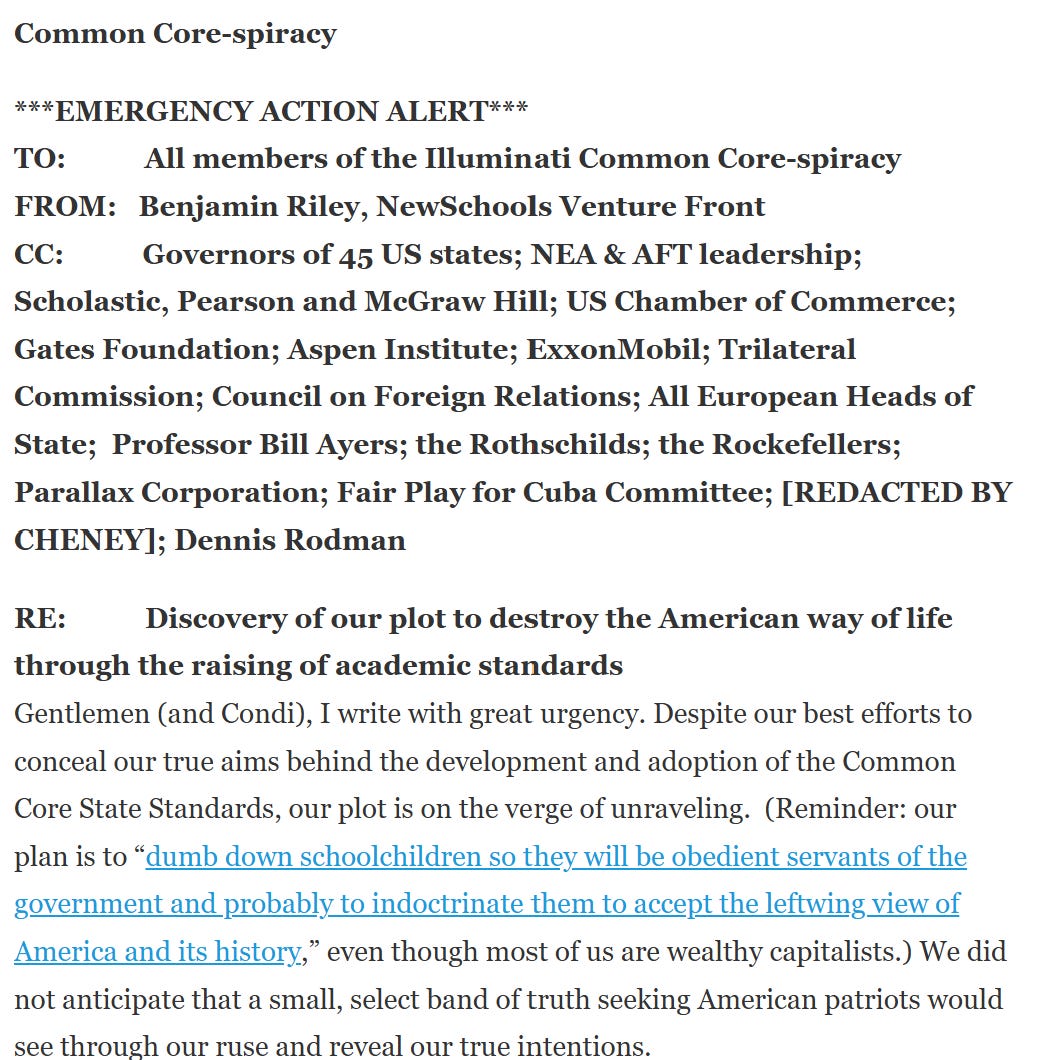
Here’s what really happened: in a preview of MAGA politics to come, the right-wing base was whipped into a frenzy by Glenn Beck and Michele Malkin, two leading conservative “influencers” at the time. Their shared concern was that the academic standards did not sequentially build knowledge in proper E.D. Hirsch-approved fashion. Just kidding. Their actual reasons for opposing Common Core were instead insane, a grand conspiracy theory involving the United Nations trying to indoctrinate kids with communism. It was so absurd that one mid-career edu-policy professional even wrote a satirical blog post in 2013 that went mini-viral among DC eduwonks:
Bizarre and dumb as all this was, the die was cast: people just didn’t like the ed-reform agenda. Just as the Common Core brand was unraveling on the right— Marco Rubio took to calling it “Obama Core” — parents were simultaneously mobilizing to “opt out” of NCLB’s high-stakes standardized testing.
This is misremembered today as a woke-progressive effort emanating from the left, and while that is partially true — Diane Ravitch enters the chat — in reality, many families who opted out were wealthy, white, and located in moderate-to-conservative suburban communities. Don’t believe us? Consider that in 2015 in deep-blue New York City, with powerful teachers’ unions and a then-newly elected progressive mayor, had an opt-out rate of 1.4 percent. Meanwhile, the figure for nearby suburban Nassau and Suffolk counties on Long Island was 50 percent. These same communities would later become MAGA strongholds.
And so:
Conservatives fought to end No Child Left Behind. Conservatives rejected the Common Core. Conservatives opted their children out of standardized tests. Why would they come back to the table now for a do-over of classic ed-reform policies?
The answer is they won’t, because they have a new goal in mind: parent choice, with an emphasis on parent. It is not the same as school choice.
The general idea animating school vouchers can be traced back to libertarian Milton Friedman in the 1950s, but it made little headway politically until the past decade, and has metastasized quickly just in the last year. Why?
The answer is that the right has quietly been building an intellectual ecosystem to advance parent choice via Education Savings Accounts, with the aim of hollowing out public education entirely. The Koch brothers have long understood that ideas matter in politics, and their basic belief is that “government schools” are bad, and they must die. But unlike Milton Friedman or the Koch family, parent-choice enthusiasts today are not motivated by competition driving school improvement or raising students’ academic proficiency, the market does not move them. They don’t care about this in the slightest.
Instead, they are driven by more personal — and even spiritual — motivations.
Nicole Garnett and Richard Garnett, married professors who make their academic home at the University of Notre Dame law school, are not widely known figures among the ed-reform crowd, and not of the type typically invited to speak at the NewSchools Summit or the ASU+GSV ed-tech conference. But they are true intellectuals, and hugely influential on the political right nowadays when it comes to education policy. Nicole sits on the board of the Federalist Society and clerked for Supreme Justice Clarence Thomas, while Richard clerked for Chief Justice Rehnquist. The Garnetts are also close friends of Justice Amy Coney Barrett.
In 2023, writing in the City Journal, the Garnetts laid out their argument in support of parent choice, and they did not mince words (our emphasis in bold):
A revolution is underway in American education…Education Savings Accounts represent a definitive and principled move beyond school choice to parental choice. While these terms have been used interchangeably for decades, education reformers historically have focused on giving parents choices among different types of schools (district, charter, and private) rather than between schools and other educational options…[ESAs] tap into the traditional principle that parents are the first and primary educators of their children. They are true parental-choice programs, and catalysts for real-world education pluralism and diversity, giving parents the option of using the public dollars allocated for their children’s education not only for tuition but also for “microschooling,” instructional materials for homeschooling, tutoring, and education therapies.
That revolution is indeed underway. Under parent choice, whether children learn is simply not the state’s concern. Parents decide whether their children learn, if they choose to care about this at all. But policy-wise, once public money is in parental hands, the state’s role in education is finished.
As for the spiritual component, consider the book the Garretts co-edited, The Case for Parental Choice: God, Family, and Educational Liberty — the title is a tell. The book features a series of essays by John Coons, a law professor at UC Berkeley, and himself a major figure in the new intellectual ecosystem driving the right. Coons believes that “God and his will for humankind” should play a central role in resolving policy decisions, and He plays a foundational role in animating Coons’s belief in “shifting educational authority from government to parents.”
Why bother persuading state superintendents when you have the Lord Almighty in your corner?
Meanwhile, there’s been tremendous enthusiasm for ESAs by red-state leaders, even though many families seem to be using funds for secular rather than godly pursuits. Parents are using public dollars intended for educational purposes to purchase lingerie and jet-skis and also Roblox and gaming consoles and also paddleboards and flatscreen TVs and also going to Disneyworld. Arizona, often a pioneer in bad ideas in education policy, is leading the way with ESAs, with Texas and Florida nipping on their heels (along with many other red states and even some blue), and soon the federal “Education Freedom Tax Credit” will kick in.
If you’re into parental choice, it’s an exciting time to be alive, though we’ll see if that remains true after the midterms.
Intellectuals and policymakers on the right are thus in harmony around ESAs — but what about the grassroots? That’s a trickier story. Take Texas — if you are a billionaire software executive in Austin who wants to replace teachers with AI, to pick an example not entirely at random, you’ll eagerly embrace the rhetoric and politics of parent choice. But out in rural west Texas, after families on the political right finish their fancy Friday night dinners at The Cheesecake Factory, many will go watch the local public high school football team play under public bright lights. These families and their political representatives are under no illusions about how many school choices they will have locally. The local public schools are pillars of local pride. Meanwhile, ed reformers both right and left fly over these communities on their way to coastal conferences to discuss outcomes-based contracting and strategic staffing.
And yet, whenever the press uncovers the inevitable misuse of ESA public funds for non-educational ends, the power structure of the right yawns. When a legislative audit found that Florida lost track of 30,000 voucher recipients and couldn’t track down $270 million in public funding, the state’s education department…shrugged. Under a regime of parent choice, addressing such malfeasance just isn’t the state’s responsibility anymore. If parents want to spend their ESA money on lingerie and Playstations, this might make John Coons sad, but it won’t undermine his fundamental — or perhaps fundamentalist? — belief that parents get to decide how to spend public dollars for private means.
Parents choose, and the public pays.
All this explains why the ed reformers, even those on the center-right, are so out of step with America’s new political right. To be sure, they may be whipped into collective action by philanthropists or podcasters around whatever the latest edu-fad is — out goes High Quality Instructional Materials, in comes Direct Instruction or whatever else. But guess who doesn’t give a shit? That would be Lindsey Burke, the former Heritage Foundation staffer turned deputy chief of staff for policies and program at the US Department of Education (whatever is left of it), who recently told a gathering of the Association of Classical Christian Schools that she was “optimistic that, you know, in five years time the majority of kids are going to be in a private school choice program.” The same goes for Tiffany Justice, co-founder of Moms for Liberty, who told Pro Publica last year that she wants the percentage of public-school students to be “zero, I hope to get to zero.”
We missed the part where Tiffany Justice added, “but only if we ensure homeschooling families are required to use a knowledge-rich curriculum.” Somewhere, Robert Pondiscio weeps. Or does whatever this is:

But enough about the center-right ed reformers, what about those on the center left? Turns out they are making the same basic mistake, and thus missing what is right in front of their face too.
Consider Andy Rotherham, a godfather of the ed-reform movement generally, a chief proselytizer for its central tenets and someone who believes deeply that politics should be about compromise and negotiation, all the rosy stuff that happens in Schoolhouse Rock. He is generally situated on the center-left of ed-reform — he cut his policy teeth in the Bill Clinton era, though he likes to play footsie with the center-right or even the right-right (having recently worked with Glenn Youngkin). Last year, in an essay published by the Fordham Institute, Rotherham argued that when it comes to ESAs, Democrats should just roll over adopt an acceptably moderate position:
“This is America—we like choice. Being on the wrong side of that culturally and politically is not a great place to be. A flat ‘no,’ or even the perception of being a party of no, isn’t a viable long-term strategy.”
As such, he urges Democrats to embrace “choice plus accountability” — no shocker there, as this has been the central premise of the neoliberal vision that underpins all of ed reform. But the problem for center-left ed reformers such as Rotherham and Arne Duncan is that the actual left doesn’t want ed reform any more than the right does.
Instead, what parents on the left really want is their public schools back, the ones they remember happily attending in their childhood before ed reform was a thing, with teachers who didn’t have to spend months on test prep, and in classrooms that hadn’t been ravaged by Big Tech and other ed-tech intrusions. Consider that, in the span of just two years, Schools Beyond Screens has grown from a handful of families in Los Angeles to an organization with more than 270 chapters nationwide, part of a “techlash” that speaks to the broader social rejection of AI. (Disclosure: Ben has worked informally to support SBS’s efforts.) These efforts are nonpartisan, and stretch far beyond the left and education policy, as anti-AI sentiment is proving to be the one thing healing partisan divides in this country, “the most bipartisan issue since beer.”
As go the data centers, so go our schools.
This is why the odds of “choice plus accountability” becoming the new, or rather recycled, education policy of any future Democratic administration are the same as Rahm Emanuel being the Democratic Presidential nominee, which is to say, zero. Memo to center-left ed reformers who migrate across the conference circuit: While you’ve been gathering in our nation’s finest hotels, millions of people are marching on the street at No Kings! rallies, a grassroots mass-mobilization effort aimed at defeating the authoritarian right that’s seized control of the federal government. “Choice plus accountability” is not a chant you will hear at these events. “Save our public schools” definitely is.
On the left, ed reform is dead, and it’s never coming back. Ross Wiener gets it, and has renounced the errors of his former ed-reforming ways. So does Annie Abrams, she who offers an erudite vision that sounds in the best version of progressive ideals of what public education could and should be. Alicia Stoller gets it too. And at heart it’s simply this:
The left wants good public schools.
So that’s a flat no to ESAs, now and forever, and if Democrats don’t figure that out soon, parents will seek out the politicians and parties who do — we’re looking at you, Democratic Socialists of America, as is Audrey Watters. So too will teachers, students, and anyone who still believes in public education as an essential public good. The ed-reform agenda severely weakened public schooling in America, the right is moving in for the kill, and so now the left must do what it has so often done in this country’s history, however imperfectly — organize and fight for social justice. The fight must be taken to the street, the ballot box, and the schoolhouse door.
We must fight for public schools.
Ah, but what about teachers’ unions and their foolish decision to partner with the Big Tech oligarchy? For that matter, what about the entire philanthropic ecosystem that largely exists because of that same oligarchy? And how about the rapid collapse of higher education as an independent node of resistance to tyranny? All good questions, and very hard questions, but we’ll just have to save them for a future essay or three.
Because:
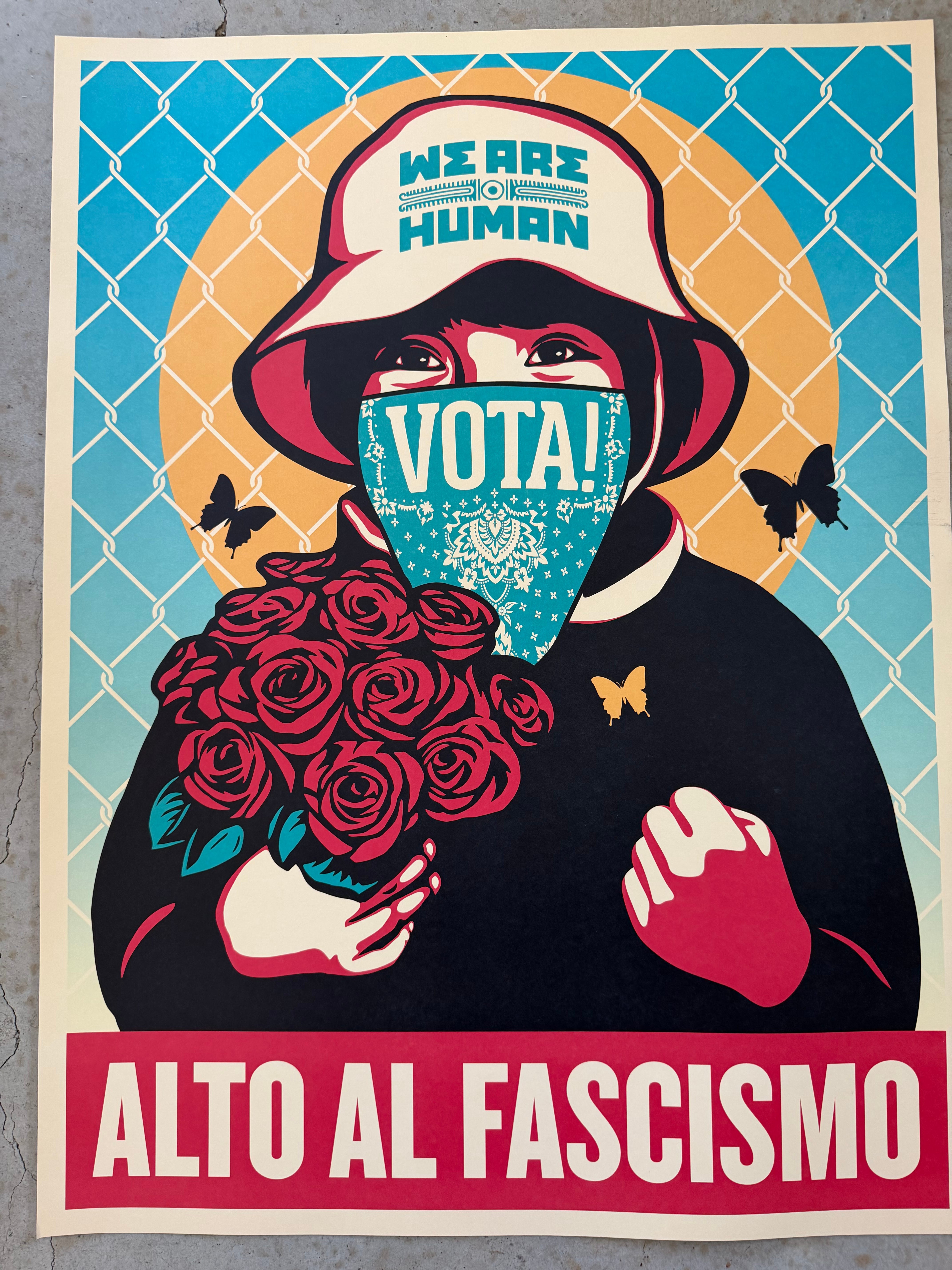
The midterm elections have arrived in the US, so please go vote on Tuesday (or earlier if you can), and proudly wear your “I voted!” or “¡Yo Voté!” sticker afterward. It’s a tiny but important affirmation of your civic commitment to democracy and civil rights, something that so many Americans — especially Black and brown Americans — have fought so hard to secure, many of them making the ultimate sacrifice in the process. We honor that history, and carry it forward through our democratic tradition, when we vote.
And remember to vote — or perhaps even run — in your school board elections, too. They are just as important to democracy. Maybe now more important than ever before.
“History, as nearly no one seems to know, is not merely something to be read. And it does not refer merely, or even principally, to the past. On the contrary, the great force of history comes from the fact that we carry it within us, are unconsciously controlled by it in many ways, and history is literally present in all that we do.”
— James Baldwin

I wanted to hop in and thank Benjamin Riley for inviting me to co-author today's piece. Been a fan of his work and voices like Ben's are sorely needed. It was great to have his added push to make my original thoughts more actionable, too. Go vote!
Having slept on it and rereading what went out this morning, I want to add one more bit of my perspective. The politics of backlash can be creative or destructive. When the system, be it educational institutions, the financial system, healthcare, or big tech, fails to deliver benefits to the people it's meant to serve, those people get fed up. We've seen voters empower the destructive side. That's who is "zeroing" out public schools. That's who is privatizing the public infrastructure of education.
What if the ongoing backlash generated by the last 25 years of technocratic meddling led to a politics of creation instead of destruction? What if we chose differently? It starts Tuesday, if only as a way to slow the destruction of our invaluable public schools, but it can't end there. We, not politicians or distant technocrats, have to come up with the creative path so our leaders can walk it.
Absolutely all of this.